
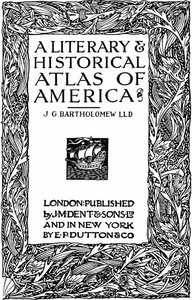
A Literary & Historical Atlas of America by J. G. Bartholomew
Let's be clear: this is not a novel. You won't find a plot with heroes and villains. Instead, 'A Literary & Historical Atlas of America' presents the plot of a nation being written onto the land itself. Published in the early 20th century by Scottish cartographer J.G. Bartholomew, it uses maps as its primary language. But these aren't just topographical charts. Each section pairs detailed maps—showing everything from colonial settlements and Civil War battlefields to railway expansions—with relevant excerpts from American literature and historical notes.
The Story
The 'story' is the unfolding of America. It starts with the early geographical knowledge of the continent, moves through territorial growth, and documents the infrastructure that connected it. Bartholomew acts as your guide, but he lets the maps and selected writings from authors like Washington Irving and Francis Parkman do most of the talking. You see the physical challenges of the Oregon Trail, then read a firsthand account of the journey. You view a map of Gettysburg, then consider the literary weight of the conflict. The narrative is visual and historical, charting how an idea became a place.
Why You Should Read It
What I love most is how it connects dots we often see separately. We learn history from books and geography from maps, but this volume smashes them together. Seeing a quote from 'Moby-Dick' placed beside a whaling chart of the 1850s gives you chills—it grounds the epic story in a real, navigable world. Bartholomew had a vision of history as a multi-layered thing, and flipping through this atlas feels like peeling back those layers. It makes you realize that every road and river on a modern map has a century of stories buried underneath it. It’s a contemplative, almost detective-like experience for the reader.
Final Verdict
This is a perfect book for the curious browser, the history buff who loves old maps, or the literature fan who wants to see the settings of classic novels. It's not a cover-to-cover read, but a book to explore slowly, getting lost in one fascinating page at a time. If you enjoy connecting facts to form a bigger picture, or if you just love the smell and feel of a beautifully made old book, this atlas is a treasure. Just be warned: you'll start looking at your road atlas very differently afterward.
You are viewing a work that belongs to the global public domain. Distribute this work to help spread literacy.
George Hill
1 year agoSimply put, it manages to explain difficult concepts in plain English. Don't hesitate to start reading.



Betty Hernandez
1 year agoGreat reference material for my coursework.