
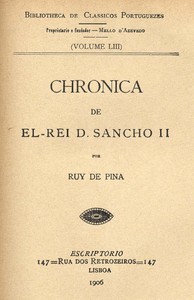
Chronica de El-Rei D. Sancho II by Rui de Pina
Ever wondered what it would be like to read the official court record of a king's spectacular downfall? That's exactly what Chronica de El-Rei D. Sancho II is. Written by Rui de Pina, the man whose job was to document the king's life, this isn't a distant history book—it's an insider account, full of immediacy and drama.
The Story
The chronicle follows Sancho II from his childhood to his tragic end. He becomes king as a boy and grows into a skilled military leader, winning battles and expanding Portuguese territory. But ruling in peacetime is a different beast. The story takes a sharp turn as Sancho struggles to control his powerful nobles, who begin to act like independent warlords. Law and order break down across the country. The crisis gets so bad that his own brother, the future Afonso III, and the bishops of Portugal make an unprecedented move: they write to the Pope, asking him to remove Sancho from power. In 1245, Pope Innocent IV does just that, declaring Sancho unfit to rule and ordering the Portuguese to obey his brother instead. The final chapters are a slow-motion tragedy, as the deposed king wanders in exile until his death.
Why You Should Read It
What grabbed me was the human drama at the center of this political earthquake. Pina paints Sancho not as a cartoon villain, but as a complex figure—brave in war yet seemingly overwhelmed by the administrative chaos of his kingdom. You're left wondering: Was he a victim of treacherous nobles and an overreaching Church, or did his own failures as an administrator cause the disaster? Reading Pina's careful (and sometimes clearly conflicted) prose, you feel the tension of a man writing about a king he served, who was removed by the very institutions that upheld the throne. It makes you think about where real power lies and how quickly legitimacy can evaporate.
Final Verdict
This is a must-read for anyone who loves real historical drama with layers of moral ambiguity. It's perfect for history buffs who want to go beyond battles and dates into the gritty reality of medieval power struggles. If you enjoy narratives about flawed leaders and institutional collapse, like many modern political biographies, you'll find its ancient concerns strikingly familiar. Just be ready—it’s not a cheerful tale of glory, but a fascinating, sobering look at how a kingdom can come undone.
Legal analysis indicates this work is in the public domain. Enjoy reading and sharing without restrictions.
Emma Jones
4 months agoBased on the summary, I decided to read it and it manages to explain difficult concepts in plain English. One of the best books I've read this year.
John Allen
2 years agoFinally a version with clear text and no errors.





John Smith
11 months agoRecommended.