
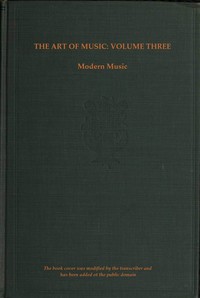
The art of music, Vol. 03 (of 14) : Modern music by Daniel Gregory Mason et al.
This isn't a novel with a plot, but the story it tells is incredibly dramatic. Picture this: it's the early 1900s. The world of classical music, long ruled by the clear rules of Beethoven and Brahms, is getting a serious shake-up. Composers like Claude Debussy are making hazy, impressionist soundscapes. Richard Strauss is pushing the orchestra to its screaming limits. A young Igor Stravinsky is about to premiere The Rite of Spring and cause a riot. The old rulebook is being tossed out the window.
The Story
The Art of Music, Vol. 3 captures the panic and excitement of that moment. Edited by Daniel Gregory Mason, it's a collection of essays from different musicians and writers of the time. They're all trying to answer one big, scary question: Where is music going? Each chapter is like a different voice in a heated salon debate. One writer passionately defends the new, complex harmonies. Another mourns the loss of beautiful, singable melody. They dissect the music of their contemporaries, arguing over what's genius and what's just chaotic noise. The 'story' is the intellectual collision between the past and the furious, uncertain future.
Why You Should Read It
I loved this because it completely humanizes a period of music history I only knew from textbooks. These aren't dusty historical figures; they're real people having a meltdown about art. Reading their worries—'Is this too intellectual?' 'Has music forgotten how to touch the heart?'—feels shockingly current. It's the same debate we have about abstract art, experimental film, or any challenging new genre today. It also gave me a new appreciation for the music itself. Putting on Debussy's La Mer after reading a 1915 critic struggle to describe its 'lack of form' is a hilarious and enlightening experience. You hear the controversy baked right into the notes.
Final Verdict
This is a perfect read for curious music lovers, history fans, or anyone who enjoys seeing how people react when their artistic world gets turned upside down. It's not a dry analysis; it's a front-row seat to a cultural argument. You don't need a PhD in music theory to follow it—just an interest in why art changes and how people fight about it. Fair warning: it's a century-old book, so some language and ideas are of their time, but that's part of its fascinating charm. Think of it as the original and most passionate music review section ever written.
Legal analysis indicates this work is in the public domain. Feel free to use it for personal or commercial purposes.
George Taylor
8 months agoAs someone working in this industry, I found the insights very accurate.
Donald Lopez
1 year agoThe clarity of the introduction set high expectations, and the footnotes provide extra depth for those who want to dig deeper. A trustworthy resource that I'll keep in my digital library.
Christopher Thomas
11 months agoThe layout of the digital version made it easy to start immediately, the way it handles controversial points with balance is quite professional. This adds significant depth to my understanding of the field.
Michael Johnson
3 months agoI took detailed notes while reading through the chapters and the author manages to bridge the gap between theory and practice effectively. This has become my go-to guide for this specific topic.


Donald Hernandez
1 year agoThis was exactly the kind of deep dive I was searching for, it manages to maintain a consistent flow even when discussing difficult topics. The price-to-value ratio here is simply unbeatable.