
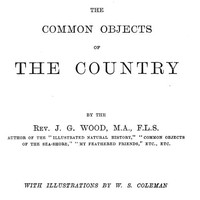
The Common Objects of the Country by J. G. Wood
First published in the 1850s, J.G. Wood's The Common Objects of the Country is a charming and detailed guide to British wildlife meant for everyday people. It's structured like a friendly tour, moving from one habitat or creature to the next.
The Story
There isn't a traditional plot with characters. Instead, the 'story' is one of discovery. Wood acts as your enthusiastic guide. He starts close to home, examining the insects in a garden, the birds at the window, and the plants growing by the roadside. Each chapter focuses on a group—beetles, butterflies, birds, reptiles, wildflowers—describing them not just with scientific facts, but with lively observations about their behavior, homes, and habits. He explains how to identify them, shares curious anecdotes, and debunks common superstitions. The narrative is the journey of looking closely, of learning to see the extraordinary in the common.
Why You Should Read It
What makes this book special is Wood's voice. He writes with the excitement of someone who just spotted something amazing and can't wait to tell you about it. His love for even the 'creepy-crawlies' is infectious. Reading it, you feel like you're on a walk with a wonderfully knowledgeable friend who keeps stopping to say, 'Wait, look at this!' He gives personality to slugs and wasps, finding dignity and intrigue where most see pests. In an age of high-tech distractions, this book is a quiet rebellion. It argues that adventure and wonder don't require traveling to distant jungles; they're waiting in the nearest patch of grass. It reawakens a simple, direct connection to nature that many of us have lost.
Final Verdict
Perfect for curious minds, gardeners, amateur naturalists, or anyone who enjoys a slow, observant walk. It's a fantastic book to dip into, a chapter at a time. If you enjoy the gentle, informative style of Gerald Durrell or the accessible science of writers like Lucy Cooke, you'll find a kindred spirit in J.G. Wood. Be aware that some of the scientific classification is outdated, but that doesn't dim the book's magic. Its real subject isn't just nature—it's the joy of paying attention. Keep a copy by your back door, and you'll never look at your yard the same way again.
This book is widely considered to be in the public domain. Enjoy reading and sharing without restrictions.
Elizabeth Lee
10 months agoI was skeptical about the depth of this book at first, but the logic behind each conclusion is easy to follow and verify. A rare gem in a sea of mediocre content.
William Garcia
3 months agoBefore I started my latest project, I read this and the language used is precise without being overly academic or confusing. Well worth the time invested in reading it.
David Johnson
2 years agoAs a professional in this niche, the inclusion of diverse viewpoints strengthens the overall narrative. A perfect balance of theory and practical advice.
Charles Lopez
8 months agoThe analytical framework presented is both innovative and robust.



Linda Martin
6 months agoThis work demonstrates a clear mastery of contemporary theories.