
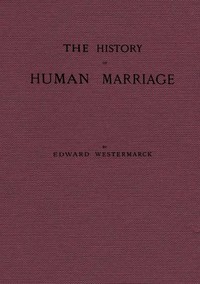
The history of human marriage by Edward Westermarck
Okay, let's set the scene. It's the late 1800s, and a lot of smart people are convinced they've figured out human origins. A popular theory, pushed by big names, said that early humans lived in a state of sexual free-for-all. Marriage, they argued, was a recent invention—a cage built by society to control chaos. Enter Edward Westermarck, a guy in his twenties who looked at all the evidence and said, "Nope. That doesn't make any sense."
The Story
This isn't a novel with a plot, but the argument itself is a thrilling intellectual showdown. Westermarck's book is his massive counter-punch. He travels through history and across continents without leaving his desk, compiling reports from missionaries, explorers, and early anthropologists. He looks at apes, tribal societies, and ancient laws. His core idea is simple but radical: the human family, built around a male-female pair, isn't a cultural cage. It's a biological and social instinct. He argues that feelings like jealousy, paternal care, and simple habit naturally led to lasting pairs, which then became the foundation for everything else—morality, law, society. The book is his mountain of evidence, trying to prove that marriage, in some form, was always there.
Why You Should Read It
Reading Westermarck today is a weirdly humbling experience. First, you get to watch a genius connect dots across a world that was still largely unmapped. His global approach was groundbreaking. Second, it makes you realize how our "common knowledge" about love and family is shaped by these old, fierce debates. When you see someone online arguing about whether monogamy is "natural," they're walking onto a battlefield Westermarck helped define over a century ago. It's not a light read—it's dense and detailed—but the central idea is powerful. It challenges you to think about whether our social structures are imposed on us or grow from within us.
Final Verdict
This book is not for everyone. It's a scholarly work from another time. But if you're a curious person fascinated by the origins of human society, or a student of history, anthropology, or sociology who wants to meet one of the founding arguers, it's essential. Think of it as the original source code for a debate about family that we're still compiling today. Perfect for history buffs, anthropology nerds, and anyone who likes seeing a bold underdog idea take on the academic establishment of its day.
No rights are reserved for this publication. It is available for public use and education.
Barbara Lee
7 months agoI have to admit, the flow of the text seems very fluid. Exceeded all my expectations.
Daniel Martin
2 years agoHaving read this twice, the clarity of the writing makes this accessible. Don't hesitate to start reading.
Logan Thompson
2 years agoText is crisp, making it easy to focus.

Karen Martinez
7 months agoJust what I was looking for.