
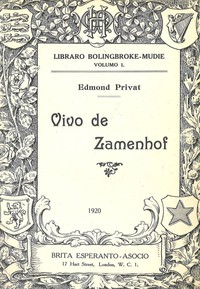
Vivo de Zamenhof by Edmond Privat
Most of us have stumbled across Esperanto—maybe in an old book or a quirky online forum. But the life of its creator, Ludwik Zamenhof, is a story few know. Edmond Privat, a close friend and fellow Esperantist, gives us an insider's view. He paints a picture of Zamenhof as a young man in Białystok, a city torn by divisions between Poles, Russians, Jews, and Germans. Witnessing this discord firsthand planted a seed: what if everyone could speak a common, neutral second language?
The Story
We follow Zamenhof from his studious youth, through medical school, and into his work as an eye doctor. The real drama isn't in grand events, but in the quiet, relentless work of a hobbyist. After years of tinkering, he publishes his first booklet on 'Lingvo Internacia' under the pseudonym 'Doktoro Esperanto' (The Hoping Doctor). The name sticks. The book traces the explosive, grassroots growth of the Esperanto movement across Europe and beyond. We see Zamenhof guiding this community, often sacrificing his own time and money, while steadfastly refusing to profit from or control his creation. The narrative is his lifelong push against skepticism, political pressures, and the sheer inertia of the world's established languages.
Why You Should Read It
This book works because it’s not really about a language; it’s about the person who believed language could be a tool for unity. Privat shows us Zamenhof's humility and his deep, almost painful optimism. You feel the weight of his mission. It’s fascinating to see how a simple idea—a shared, easy-to-learn second language—inspired a global community of idealists before the age of the internet. Reading it today, in our own divided world, Zamenhof's dream feels both beautifully naive and urgently relevant. It makes you think about the bridges we try to build, and why they matter.
Final Verdict
Perfect for readers who enjoy biographies of underdog thinkers, or anyone curious about the stories behind big ideas. If you like learning about historical figures who operated outside the mainstream, like Nikola Tesla or Ada Lovelace, you’ll connect with Zamenhof’s journey. It’s also a great pick for language lovers, of course, but you don't need to know a word of Esperanto to be pulled into this story of quiet perseverance. Ultimately, it’s for anyone who appreciates a tale about holding onto hope, even when the world isn’t quite ready to listen.
There are no legal restrictions on this material. Distribute this work to help spread literacy.
Kimberly Martinez
1 year agoAs a long-time follower of this subject matter, it manages to maintain a consistent flow even when discussing difficult topics. Definitely a five-star contribution to the field.
Ashley Williams
1 year agoOne of the most comprehensive guides I've read this year.
Paul Taylor
2 years agoHaving read the author's previous works, the case studies and practical examples provided add immense value. Highly recommended for those seeking credible information.
Karen Williams
1 year agoHaving explored several resources on this, I find that the footnotes provide extra depth for those who want to dig deeper. The price-to-value ratio here is simply unbeatable.




William Garcia
8 months agoAfter a thorough walkthrough of the table of contents, the narrative arc keeps the reader engaged while delivering factual content. Definitely a five-star contribution to the field.